The Best Training Plan, According to Science
How to increase your VO2max by 44% in 10 weeks!

What if I told you there was a research-backed training program that resulted in a 44% increase in Vo2max in just 10 weeks? That you would improve linearly, getting better every week, and that this program only took ~40 minutes a day. And that amateurs with little training background could do it.
Sign me up, right? I mean look at this graph of Vo2max improvement. Who can argue with this? You just keep improving…and there’s no sign of slowing down!
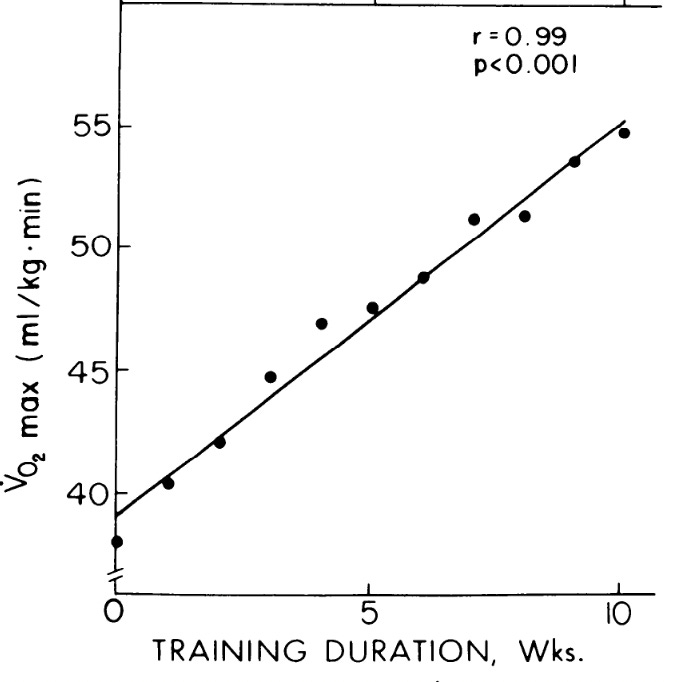
There’s just one problem with this study? The results obtained were true. Improvement was massive. But the everyone was just surviving…
When we found that Vo2max and endurance were still increasing as the study approached its conclusion, we asked the subjects if they would continue to train. Unfortunately they almost unanimously refused for the reason that they found exercise of this frequency and intensity too tiring and time-consuming. A number said they had wanted to drop out of the study but had continued out of a sense of responsibility and because they knew the study was scheduled to last only 10 wk. Only one subject trained for an additional 3 wk.
There’s a good reason that these folks didn’t want to continue. The training they were doing was absolutely insane. It consisted of:
Monday: Running: 40min “as fast as possible.”
Tuesday: Cycling: 6 x 5min at VO2max with 2min rest
Wednesday: Running: 40min “as fast as possible.”
Thursday: Cycling: 6 x 5min at VO2max with 2min rest
Friday: 40min “as fast as possible.”
Saturday: Cycling: 6 x 5min at VO2max with 2min rest
Sunday: Rest…
In other words, go hard every day. Alternate hard intervals and essentially a time trial. No easy days. Just one off day. Repeat for 10 weeks.
And they got a lot better.
So what’s the point?
You can survive crazy training for a surprisingly long time and still get better.
We tend to think that over training is always just around the corner. That if we just do a little more or go a bit faster, our performance will plummet and we’ll be fried. That’s not how it works. For a finite period of time, sometimes more than most imagine, you too can survive crazy shit. And still get better. In this study, every single person kept improving. Despite the fact that they wanted to quit and were amateurs doing a workout routine that not a single coach with knowledge would ever prescribe. They all got better, and only one person reported a minor injury.
The larger point is that: most research studies on training programs are poor. It’s not the scientists fault. It’s that the constraints placed upon them make it where you can’t learn whether a program is good or bad in such a short period of time. Because most university led studies rely on college students, most training studies are 6-10 weeks. In other words, short enough where you’ll survive no matter how crazy the training is.
We adapt to anything, even crazy stuff. Especially amateurs who have more of a clean slate. If you give people anything hard for 6-10 weeks, they will get better. And most will survive it.
And that leads to the problem we so often see now, especially in the world of health influencing. You get an 8 week study comparing some crazy intense training program to one where people just jog around really slowly, and wow, everyone on the intense program improves a lot! Then, you make your rounds on the podcast circuit declaring that the Norwegian 4x4, Tabata intervals, or whatever other workout or training program is the best. After all…there’s science!
Whenever you see that, I want you to think back to this 1977 study. One where a ludicrous training program led to everyone seeing massive gains. Thankfully, there weren’t any social media folks back then to declare it as the key. But trust, they would have.
I love research. And exercise scientist do some great work. But, whenever we are taking what goes on in the lab and translating it into the real world, we have to understand the full context. We have to be careful with extrapolating to the real world. Because at the end of the day, we aren’t trying to give advice on how people improve for 6, 8, or 10 weeks. We’re trying to give them tools and training that lasts a months, years, and maybe even a lifetime.
It’s one of the reasons why I think training research is great for explaining mechanisms and why a workout may help. But not so much for deciding whether a particular workout works well. Because the reality is, the craziest most intense workout you could design will probably get you the most bang for your buck for the 6-8 weeks. And it’s just short enough where people can survive it.
For understanding what workouts or training programs work well, we’re better off turning to history. Where we get a kind of natural experiment that occurs. And then use science to fine tune the application.
So just remember, everything works in the short term. Even the craziest training you’ve ever seen. But what matters most is what allows you to keep doing this sport for years to come.
-Steve
Research: Hickson, R. C., Bomze, H. A., & Holloszy, J. O. (1977). Linear increase in aerobic power induced by a strenuous program of endurance exercise. Journal of applied physiology: respiratory, environmental and exercise physiology, 42(3), 372–376. https://doi.org/10.1152/jappl.1977.42.3.372 https://pubmed.ncbi.nlm.nih.gov/838658/
Very interesting. I’d love to know how long these athletes maintained their increased VO2 max. If I could train for six weeks or whatever and increase my VO2 max by 40% and it resulted in a permanent or semi permanent increase of even 20% I’d go for it. I’m sure, of course, there would be some high intensity training required to maintain the improvement, but how much?
Thanks Steve! This is one of your best.